Heritage Places, Castles & Architecture  


Click on Images for Information


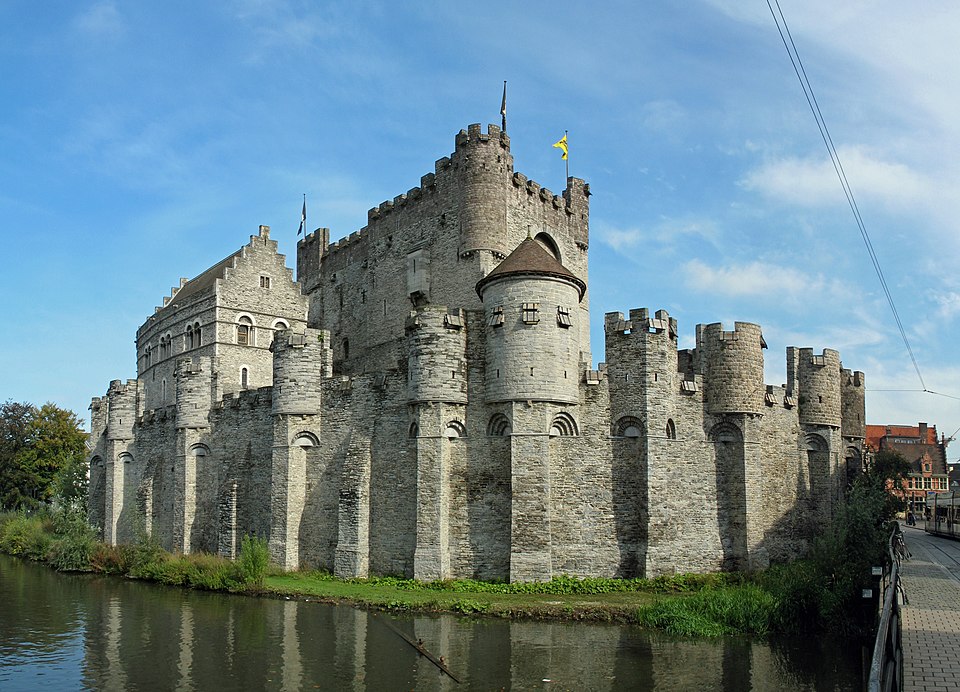
In Ghent, in the Belgian province of East Flanders, there is a medieval fortress called the Gravensteen. The present castle was built in 1180 and served as the home of Counts of Flanders until 1353. After that, it served as a court, a jail, a mint, and even a cotton factory. After being renovated between 1893 and 1903, it is currently a museum and a significant city monument. The Gravensteen has its roots in the reign of Arnulf I i.e. between 890–965. Approximately 1000 AD, the location, which was sandwiched between two branches of the Lys River, was originally defended, first with wood and then with stone. This was quickly rebuilt as a motte-and-bailey fortress, which burned down in 1176 or later. On the location of the previous fortification, Philip of Alsace ,1143–1191, erected the present castle in 1180. Perhaps it was influenced by the crusader strongholds Philip saw during the Second Crusade. In addition to serving as a fortification, the Gravensteen was designed to terrify the Ghent burghers who frequently questioned the authority of the count. It consists of several smaller buildings, a home, and a big central donjon. A 24 little échauguette-lined, oval-shaped, reinforced enceinte encircles these. Its sizable moat is likewise supplied with water from the Lys. The Counts of Flanders lived in the Gravensteen from 1180 until 1353. The castle fell into disrepair once the counts of Flanders stopped calling it home. Up to the eighteenth century, it served as a courtroom and a prison. It served as the location of mint of Ghent from 1353 until 1491. Later, private structures were built on top of or near the medieval ruins. An industrialist who bought the Gravensteen during the Industrial Revolution turned it into a cotton mill. It was even supposed to be demolished. Over time, the City of Ghent acquired portions of the castle and, under the direction of architect Joseph de Waele, undertook a significant renovation in a romanticizing Gothic style between 1893 and 1907. De Waele intended to restore the castle to its projected 12th-century appearance, using inspiration from the methods used by French architect Eugène Viollet-le-Duc. Up to the eighteenth century, it served as a courtroom and a prison. It served as the location of mint of Ghent from 1353 until 1491. Later, private structures were built on top of or near the medieval ruins. An industrialist who bought the Gravensteen during the Industrial Revolution turned it into a cotton mill. It was even supposed to be demolished. Over time, the City of Ghent acquired portions of the castle and, under the direction of architect Joseph de Waele, undertook a significant renovation in a romanticizing Gothic style between 1893 and 1907. De Waele intended to restore the castle to its projected 12th-century appearance, using inspiration from the methods used by French architect Eugène Viollet-le-Duc. It is believed that many of the characteristics added during this time, such the windows and flat roofs of the eastern outbuilding, are not historically correct. The Gravensteen served as the focal point of the 1913 Ghent World Fair, which drastically altered the downtown of the city. It is still accessible to public. #History #Architecture #Castles

This article uses text information from the Wikipedia article -- Gravensteen -- [Wikipedia-Article-Link : https://en.wikipedia.org/wiki/Gravensteen ] which is released under the -- Creative Commons Attribution-ShareAlike 4.0 License – [License-Link: https://creativecommons.org/licenses/by-sa/4.0/deed.en ( https://en.wikipedia.org/wiki/Wikipedia:Text_of_the_Creative_Commons_Attribution-ShareAlike_4.0_International_License )] [List of Principal Authors (5 or less) of the Wikipedia-Article on the date of this Article being Created in this Website: - Brigade Piron, EditorOnOccasion, Dithy, Menacinghat, Lordelicht] [Use the following Authorship tool to find out the author contributions:- https://xtools.wmcloud.org/authorship )] [The Current Article on this Website has been paraphrased from the above linked corresponding Wikipedia-Article and You may redistribute this, verbatim or modified, provided that you comply with the terms of the Creative Commons Attribution-ShareAlike 4.0 License] [License-Link: https://creativecommons.org/licenses/by-sa/4.0/deed.en ( https://en.wikipedia.org/wiki/Wikipedia:Text_of_the_Creative_Commons_Attribution-ShareAlike_4.0_International_License )]

This article also uses an image from the Wikipedia article – Gravensteen -- [Wikipedia-Article-Link : https://en.wikipedia.org/wiki/Gravensteen ] [Image: The Gravensteen, seen from the south-east; Wikipedia-Image-Author : Marc Ryckaert (MJJR) https://commons.wikimedia.org/wiki/User:MJJR ] [Wikipedia-Image-Link: https://en.wikipedia.org/wiki/File:Gent_Gravensteen_R01.jpg ] [Image Availed Under Creative Commons Attribution 3.0 Unported license;] [License-Link: https://creativecommons.org/licenses/by/3.0/deed.en ] [You may copy, distribute and transmit the work (image) or remix the work (image) and attribute the work (image) with proper license link, complying with the terms of the Creative Commons Attribution 3.0 Unported License in distribution] [License-Link: https://creativecommons.org/licenses/by/3.0/deed.en ] [Please Also Relate to Original Individual Text and Image URLs for More Usage Property and Sharing, Remixing or Attributing the Contents]
[Contents on Wikipedia is covered by -- Disclaimer – Wikipedia-Disclaimer-Link: https://en.wikipedia.org/wiki/Wikipedia:General_disclaimer ] [Contents in this Website is also covered by Disclaimer linked at the bottom of the Page] [This website article means no intellectual appropriation by any way and only wishes to contribute in sharing of knowledge]


  Heritage Places, Castles & Architecture  


Click on Images for Information



Disclaimer   Privacy Policy   Disclosure   User-Manual   Contact   About Us