Heritage Places, Castles & Architecture  


Click on Images for Information


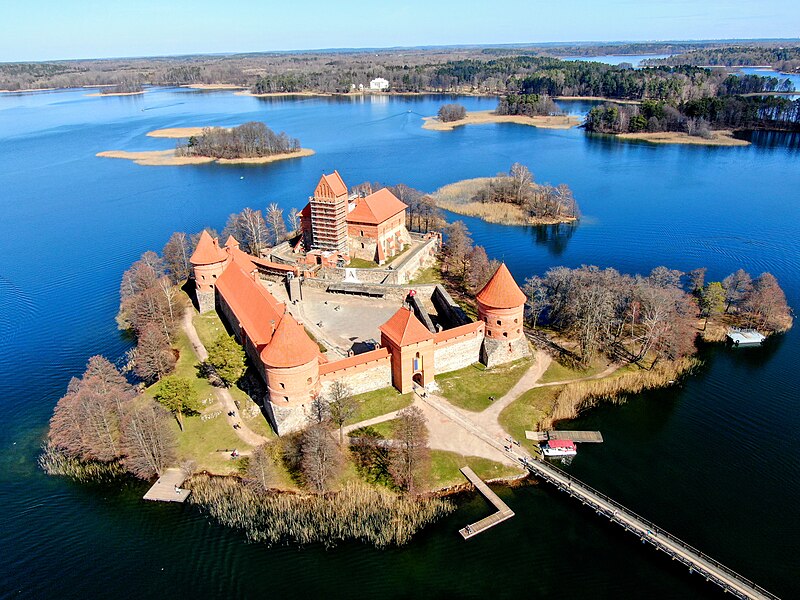
Situated on an island in Lake Galvė, Trakai, Lithuania is home to the island castle known as Trakai Island Castle. Kęstutis started building the stone castle in the fourteenth century, and his son Vytautas the Great finished most of the major construction around 1409. Vytautas the Great died in this castle in 1430. The capital of Grand Duchy of Lithuania was Trakai, and the fortress was strategically significant. Despite opposition from Soviet authorities, Lithuanian initiative led to the reconstruction of the castle in the 1950s and 1960s. With the renovation came the establishment of the Trakai History Museum. Building on Trakai Island Castle took place in stages. In the latter part of the fourteenth century, Grand Duke Kęstutis gave the order to build the castle on the largest of three lake islands during the first phase. The strengthening and enlargement of the Trakai Peninsula Castle influenced the building of Trakai Island Castle. Kęstutis relocated his treasury and principal residence to the Island Castle. Major destruction was caused to the fortress in 1377 by an attack by the Teutonic knights. Following the murder of Kęstutis, Jogaila and Vytautas the Great engaged in a power war over who would become the Grand Duke of Lithuania. Both sides were laying siege to the castle. The second phase of building began soon after Jogaila and Vytautas reconciled, and it lasted until 1409. The second stage is thought to be the most significant advancement in the castle-history. Four years before to the Battle of Grunwald, it appears that the construction project was overseen by the stonemason Radike of the Teutonic Order during the ceasefire. Two wings were added and a six-story keep was constructed on the southern side during the second phase. The palace and the castle were divided by movable gates on the keep. In addition to acting as an additional defensive construction, the keep housed living rooms and a chapel. It was connected to the inner courtyard of the multistory Ducal Palace. Wooden galleries encircled the inner wall of the inner yard, providing access to numerous support facilities without requiring one to enter the palace itself. The main building material used was known as red Gothic brick. Only the walls, towers, and foundations of buildings were constructed using stone blocks. The third stage saw a new growth with the extension of the castle in the early 15th century. The walls of the castle were raised with more fire galleries and reinforced to a 2.5-meter thickness. On the corners were built three large defensive towers. Additionally, the southwest tower used as a jail. The top level of the tower was intended for soldiers and included a sizable number of cannons. The victory of the Polish-Lithuanian army over their primary adversary, the Grand Duchy of Lithuania, at the Battle of Grunwald quickly caused Trakai Island Castle to lose its military significance. The interior of the castle was renovated and turned into a dwelling. Its walls were decorated with fresh frescoes that are still partially intact. The Ducal Palace welcomed foreign emissaries. Plans for the reconstruction of the castle were created in the 19th century. Wincenty Smokowski maintained and replicated the ancient frescoes. In 1888, the Imperial Archaeological Commission began recording the surviving castle. The officials of Imperial Russia made the decision to partially rebuild the castle ruins in 1905. A significant reconstruction project was initiated in 1946, with substantial work commencing in 1951–1952. 1961 saw the completion of the majority of the renovation. The castle was rebuilt in the manner of the fifteenth century. Today, Trakai Island Castle is a popular destination for tourists. #Castles #History #Architecture

This article uses text information from the Wikipedia article -- Trakai_Island_Castle -- [Wikipedia-Article-Link : https://en.wikipedia.org/wiki/Trakai_Island_Castle ] which is released under the -- Creative Commons Attribution-ShareAlike License 4.0 -- [License-Link: https://en.wikipedia.org/wiki/Wikipedia:Text_of_the_Creative_Commons_Attribution-ShareAlike_4.0_International_License ] [List of Principal Authors (5 or less) of the Wikipedia-Article on the date of this Article being Created in this Website : - M.K , Renata3 , Novickas , Fattonyni , Kebeta] [Use the following Authorship tool to find out the author contributions :- https://xtools.wmcloud.org/authorship ] [The Current Article on this Website has been paraphrased from the above linked corresponding Wikipedia-Article and You may redistribute this, verbatim or modified, provided that you comply with the terms of the Creative Commons Attribution-ShareAlike License 4.0 ] [License-Link: https://en.wikipedia.org/wiki/Wikipedia:Text_of_the_Creative_Commons_Attribution-ShareAlike_4.0_International_License ]

This article also uses an image from the Wikipedia article -- Trakai_Island_Castle -- [Wikipedia-Article-Link : https://en.wikipedia.org/wiki/Trakai_Island_Castle ] [Image : Trakai Island Castle; Wikipedia-Image-Author : Metsavend] [Wikipedia-Image-Link: https://en.wikipedia.org/wiki/File:Trakai_linnus.jpg ] [Image Availed Under Creative Commons Attribution-Share Alike 4.0 International License;] [License-Link : https://creativecommons.org/licenses/by-sa/4.0/deed.en ] [You may copy, distribute and transmit the work (image) or share (alike) the work (image), provided that you comply with the terms of the Creative Commons Attribution-Share Alike 4.0 International License or other compatible license in distribution] [License-Link : https://creativecommons.org/licenses/by-sa/4.0/deed.en ] [Please Also Relate to Original Individual Text and Image URLs for More Usage Property and Sharing, Remixing or Attributing the Contents]
[Contents on Wikipedia is covered by -- Disclaimer -- [Wikipedia-Disclaimer-Link: https://en.wikipedia.org/wiki/Wikipedia:General_disclaimer ] [Contents in this Website is also covered by Disclaimer linked at the bottom of the Page]  [This website article means no intellectual appropriation by any way and only wishes to contribute in sharing of knowledge]


  Heritage Places, Castles & Architecture  


Click on Images for Information



Disclaimer   Privacy Policy   Disclosure   User-Manual   Contact   About Us